
Deep-dive: co-living
Co-living in Budapest is still a niche — one we intend to define,
and to expand. The research came first.
A category, defined
Co-living is professionally managed shared housing: private rooms that are smaller but sharper, genuinely communal spaces, and a curated residential experience — designed and operated as a single coherent product. It is not a flatshare, and it is not a serviced apartment. What makes it work — and what makes it valuable — is that someone is responsible for the whole experience, not just the square metres. That is what makes it measurable, repeatable and an asset class.
Standard housing hands over a key and leaves the rest — meeting people, building a life, feeling at home in a new city — entirely to the tenant. Co-living designs it in: community as part of the brief, one all-inclusive rate covering everything from furniture to internet, and tenure that matches how mobile professionals actually live. The value is not that it is cheaper. It is that it is complete.
A well-run co-living property earns more from the same walls: more revenue per square metre than a standard furnished let, a product with an identity that does not compete on price, and one professional relationship in place of four or five separate tenancies. The largest study of the field — SPACE10’s One Shared House 2030, with 14,000 respondents across 147 countries — found that people choose shared living for the two oldest reasons there are: company, and shared cost. Institutional capital across Europe has followed that demand into the sector.
Co-living entered our practice as a research question, not a business plan. We have been studying how architecture, community and changing ways of living shape the future of housing — in an academic study, in a published article series, and in concept work. That foundation is why our answer to co-living is design-led: we understood the model deeply.
We authored a full study on the forward-looking value of shared living — examining the model’s history, its contemporary European forms, the design principles that make communities work, and the economic logic that makes the format investable. The study’s core argument has only strengthened since: co-living rewards those who treat it as a design discipline — the ratio of shared to private space, the size of each community cluster, the quality of the daily experience — rather than as a densification trick.
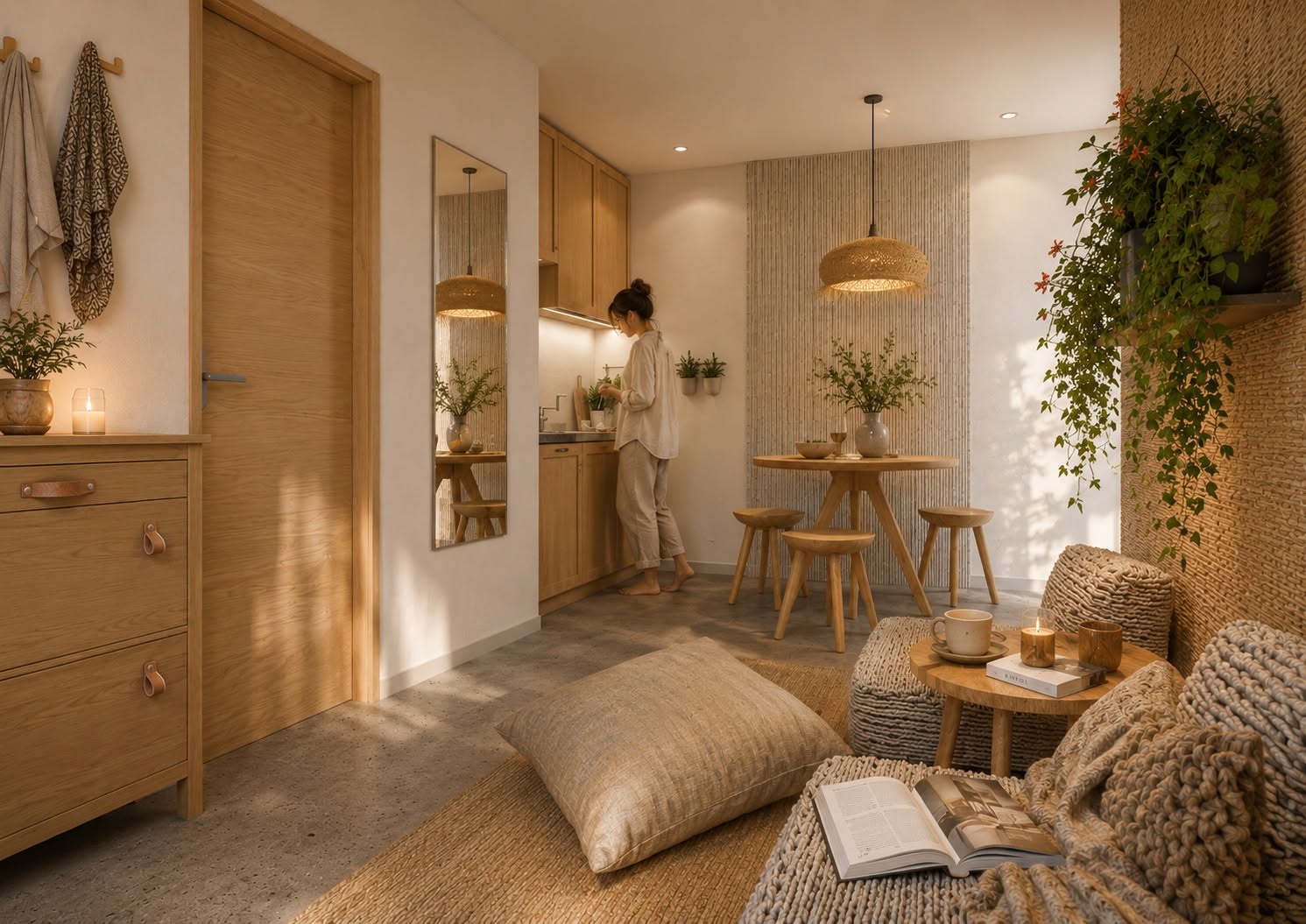 Render: Eszter Bolgár
A three-part deep-dive
Shared living from every angle, published in Hungary’s leading architecture and design magazine: the concepts, the history, and the contemporary examples.
The forward-looking value of shared living
Our full study on the model — typologies, community design principles, and the economic logic of shared living, written years before the market arrived. It is the intellectual foundation of everything on this page; current numbers live in the per-property business cases we prepare.
“Prove it small, price it honestly, manage it well.”
Co-living is an established and growing asset class, with multiple operators proving the model across European markets. It is also a young one, and its first wave taught a clear lesson: the pioneers who expanded fastest on aggressive debt did not survive their first occupancy dip. The lesson is the thesis — co-living rewards design-led differentiation and operational discipline, not scale for its own sake. That is the path we are on.
Curious what it means for your property?
Tell us about your building or apartment — we prepare the business case.
Let’s talk