
Our vision for Budapest
The European co-living market has proven the model works. What it has not yet done is make it interesting. Our ambition for Budapest is different.
Authored spaces, not neutral products
Walk into a typical large-operator co-living unit in Warsaw, Madrid or Berlin and you will find the same thing: white walls, clean lines, generic furniture, adequate lighting. Operationally competent. Spatially forgettable.
Budapest deserves better — and our starting point is different. Every property we touch begins with a genuine spatial concept: the building’s history, the neighbourhood’s character, the materiality of the walls and floors. The result is not a refurbishment. It is an authored space — one with a point of view, worth choosing over the alternative, that holds its value because it cannot be copied.
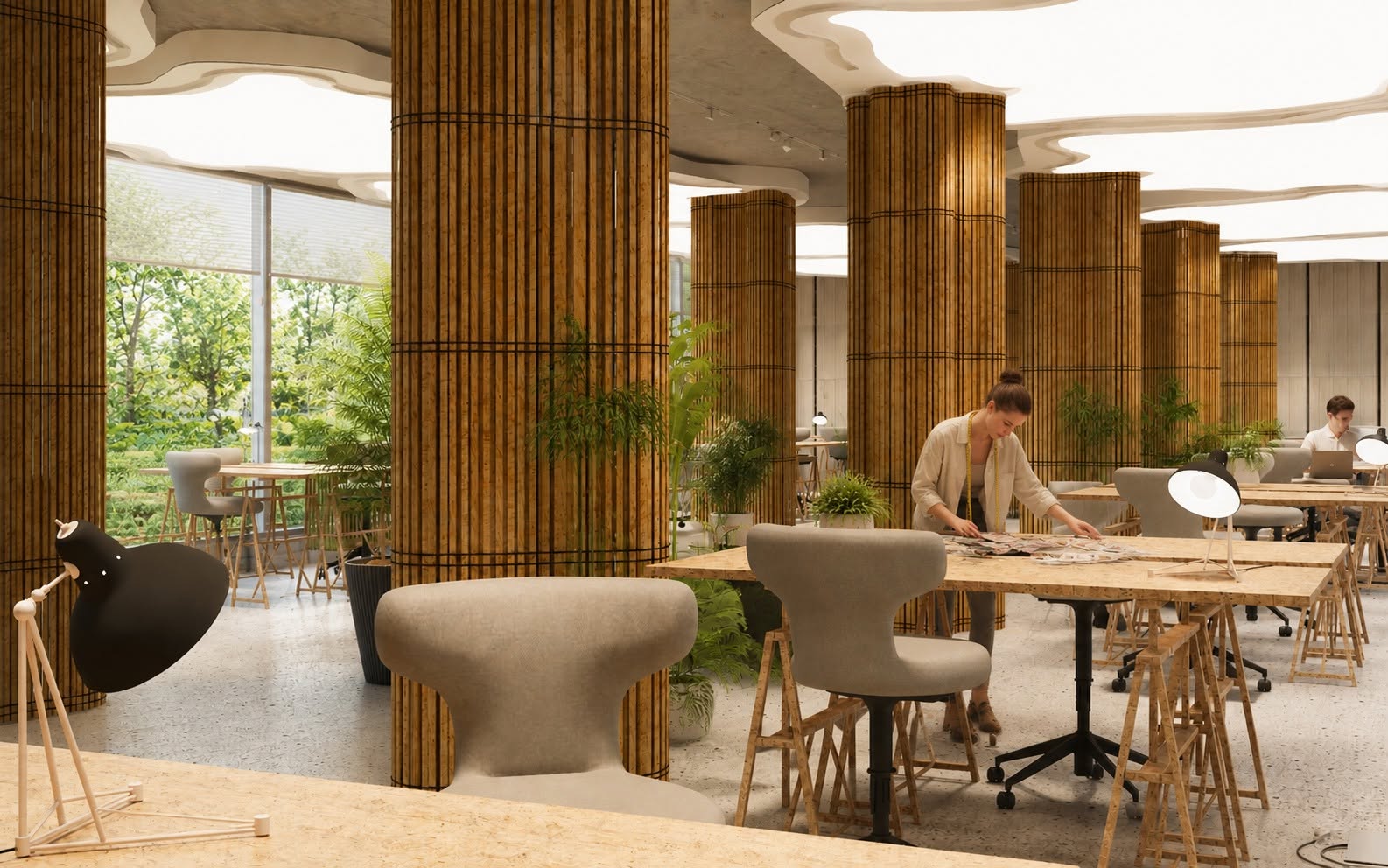 Render: Eszter Bolgár
The building stock is the competitive advantage
The pre-war apartment buildings of Districts VI, VII, VIII and IX — 3.5-metre ceilings, ornate stairwells, generous room proportions, layered histories — are structurally extraordinary spaces for co-living. So are the former factory buildings of Józsefváros and the industrial warehouses along the Danube corridor.
No new-build co-living project in London or Berlin can buy this. It is not a constraint to be worked around; it is the asset. Converting these buildings well — preserving their character while making them function as contemporary shared homes — is a design challenge, and one freeform is specifically positioned to take on.
The courtyard as communal heart
Budapest’s defining residential typology — the ‘bérház’, the internal courtyard building — is architecturally predisposed to shared living. The courtyard is not leftover space; it is the social spine of the building. In the co-living context it becomes the community hub: landscaped, programmed, genuinely inhabited.
This is also how belonging scales. People want to feel part of something human-sized — so community is designed in clusters: a house within a building, a floor that knows itself, never one anonymous mass. One research calls this “social spaciousness” — designing for the accidental encounters that turn neighbours into a community. No operator has exploited the courtyard typology properly yet.
Rooted in Budapest, not imported
Budapest has a creative identity that is genuinely its own — the craft traditions in ceramics and furniture, the art scene concentrated in some districts, the broader Central European design sensibility. A co-living product that draws on this feels categorically different from one that imports Scandinavian minimalism or Shoreditch industrial as an off-the-shelf aesthetic.
freeform’s position — a Budapest design studio with international exhibition presence and curatorial depth — is to make co-living that is unmistakably here: spaces a resident in Budapest could not find in Amsterdam, and would not want to leave.
Built for the new Budapest resident
The people arriving in Budapest have high expectations of their physical environment; they have lived well elsewhere. The market currently offers them a bedsit or a hotel. Co-living, properly executed, fills that gap — not as affordable housing, but as a genuine residential product for people who want to be in Budapest, not merely housed in it.