
Investment thesis
Co-living is where the economics of the city, the shape of a generation, and the cost of loneliness converge to create a new way of living.
Converting a property to co-living costs more than refreshing it for the rental market, so this is a long-term position, not a quick uplift. In exchange, the modelled outcome — in the European evidence and in our own work — is a meaningful revenue upside over traditional letting, and a more resilient one: an all-inclusive product with an active community holds occupancy and value through market shifts better than an anonymous flat.
The return is built on three levers that must be designed, not hoped for: how sharply private space is optimised against shared space, all-inclusive pricing, and occupancy kept high by real management. We prepare a property-specific business case for every serious enquiry.
Request a business caseCheap to enter, fast to appreciate
Among comparable European capitals, Budapest is one of the lowest-priced points of entry — and at the same time the EU’s fastest-appreciating housing market: according to Eurostat, Hungarian prices have nearly quadrupled since 2015 (+290%). The chart puts the three together: what entry costs, what the walls earn, and how fast the market has grown.
Horizontal: price, €/sqm, city average (Q1 2026) · Vertical: price growth, %, city average, 2 years · Bubble: relative gross yield, %, city average (H1 2026)
Source: Global Property Guide — prices per sqm (Q1 2026), two-year price growth (Q1 2024–Q1 2026), and gross rental yields (H1 2026); city averages.
The yield problem co-living answers
Budapest’s plain rental yields have compressed as prices outran rents — for an owner, the standard furnished let is a thinning return. Co-living is the response: more revenue per square metre from the same walls, without competing in the crowded middle of the long-term market.
The demand engine
Budapest has rapidly become one of Central Europe’s most attractive destinations for professionals in technology, fintech, financial services, and the creative industries. The housing market, however, has yet to evolve at the same pace. Many of these internationally mobile professionals are in the early stages of their careers, moving between cities as opportunities arise. Rather than seeking permanent homes, they look for high-quality places to live for the medium term — typically for a few years. They expect an environment that supports both work and life, yet the market is still dominated by conventional rental apartments and hotels. The gap between these evolving expectations and the existing housing offer is the opportunity we are building for.
Behind the demand is simple arithmetic. Hungary completed 1.4 new dwellings per 1,000 citizens in 2024 — the second-lowest rate in Europe, and falling. Buying a first home is blocked twice over: relatively high mortgage rates and a price of 11.4 gross annual salaries for a 70 sqm new flat in Budapest. Scarce supply and captive demand have kept prices climbing — and the market consensus expects appreciation to continue, at a calmer pace. For an investor, the return has two engines: the asset appreciates with the market, and co-living makes it earn more than ordinary letting while it does.
Almost nothing new is being built
— and buying is getting more out of reach
— so prices keep climbing
Source: Deloitte Property Index 2025 (2024 data) — completed dwellings per 1,000 citizens, national; own-housing affordability, cities · Global Property Guide — two-year price growth, city averages.
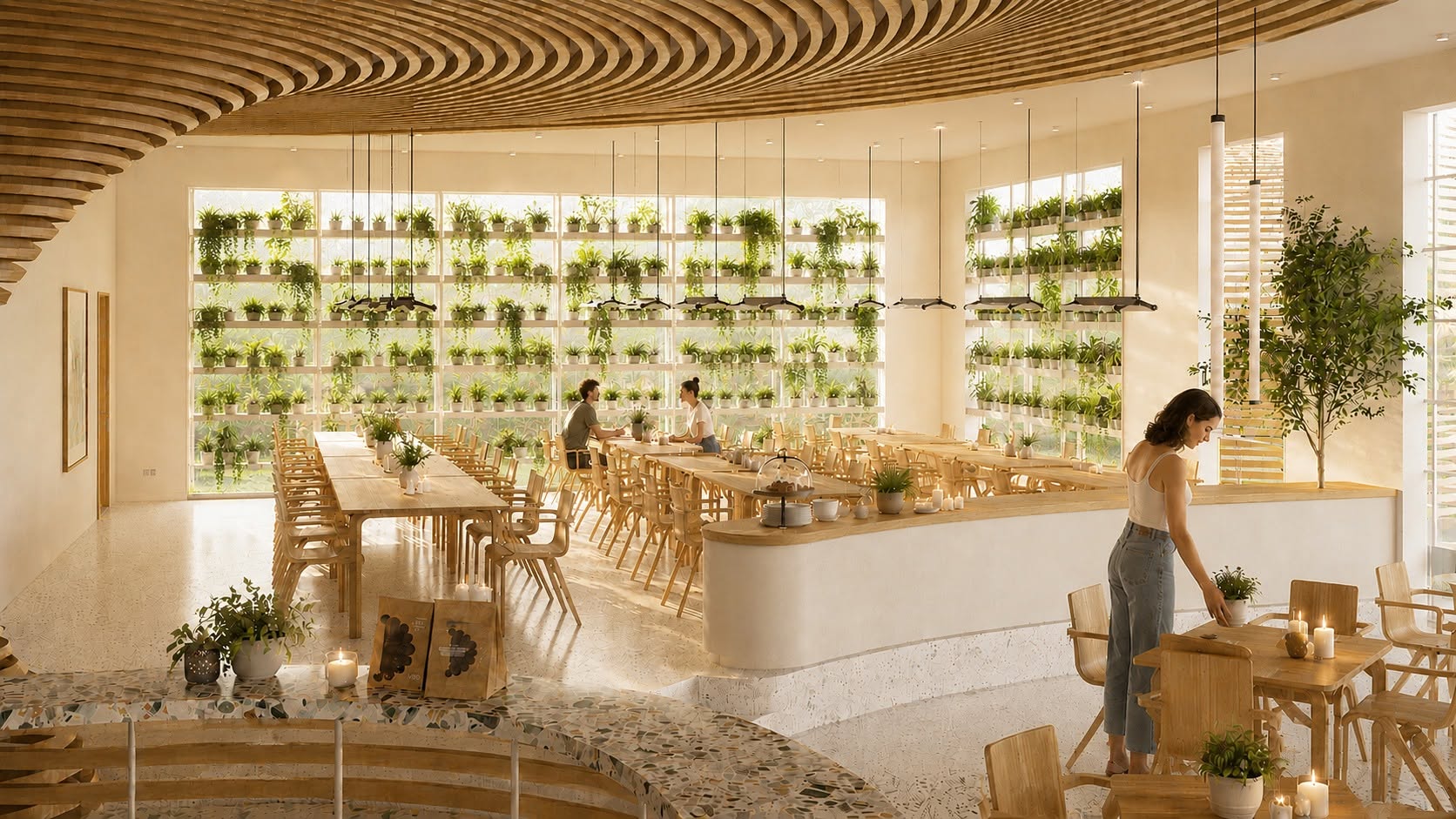 Render: Eszter Bolgár
Three signals, one window
Regulation redraws the map
District VI’s short-term-let ban took effect in January 2026, pulling competing short-stay supply off the market. Co-living — longer stays, professionally run, community-anchored — is the natural bridge between the contracting short-let market and the growing international rental market.
Yields have compressed
The traditional letting model is producing less every year. Owners are actively looking for the next model — and the ones who move first will set the standard, and take the best buildings.
The field is still open
No design-led co-living operator has yet established itself in Budapest. The window operators walked through in Prague — affordability pressure, international talent influx, no established player — is still open here.
Two kinds of investor, one model
Co-living scales, and so does the way in. We work with two kinds of investor — not on two separate tracks, but at two entry points of the same thesis.
You own one or a few apartments, and the standard furnished let is earning less every year. You need confidence, a clear productised route, and a real reference — not a concept deck. For you, freeform designs, brands and — where you want it — runs the property: one conversation replaces five. Our pilot — in construction — is exactly this case.
You are entering at floor, building or portfolio scale — as a Hungarian or foreign investor, fund or operator. You need market evidence, design credibility, and a partner who understands both the asset class and this city’s building stock. For you, freeform is the concept and design partner from the first brief — shaping a building with an identity no competitor can replicate — and we connect operations through our network.
Same thesis, different entry points.
The residents
Investors ask who will actually live in these rooms. Five faces — one common need: a complete, medium-term home that works from day one.
The graduate student
Master’s and doctoral students at Budapest’s universities. They are looking for safety and simplicity: one contract, one monthly payment, a well-run home that can be trusted from a distance.
The young professional
Early-career talent in tech, finance and the creative industries, often newly arrived in the city. They are looking for a ready-made life: furnished, all-inclusive, a community from day one, and a good district within reach of work — and of everything after work.
The relocating expat
Professionals arriving on a one-to-three-year assignment or a new contract. They are looking for a soft landing: move in with a suitcase, no furniture to buy, English-speaking management — and housemates who already know the city.
The remote worker
Location-independent professionals basing themselves in Budapest for a season or a year. They are looking for a work-ready home and a social circle — without a long lease, and without the anonymity of an individual rental.
The local in transition
Locals returning from years abroad, or starting a new chapter of life. They are looking for flexibility without isolation: a real home between homes, not a compromise.
Why freeform
Two perspectives, one process
Co-living sits exactly where spatial concept, design execution and investment logic meet — and freeform is one of the few studios that holds the economic and the curatorial in the same hands. Timi reads a property the way an investor does: feasibility, market position, the business case. Eszter reads it the way a curator does: narrative, cultural context, the experience of living there. Every project passes through both readings.
We did the thinking first
We authored a full study on the economics of shared living and published a series in Hungary’s leading architecture magazine — co-living is a subject we researched for years before it became our product.
We are building, not just advising
Our first co-living property is in construction now. Every recommendation we make to an investor is one we are testing with our own hands.
The design credentials are real
EDIDA Product of the Year 2025 for the Spheres collection; exhibitions in Milan, Berlin and at Maison & Objet Paris; published in Elle Decoration and Octogon. The same standard goes into a co-living room as into an award-winning product.
Have a property in mind?
Tell us about your building or apartment — we prepare the business case.
Let’s talk